도널드 트럼프 미국 대통령은 현지시간 4일 미일 무역협정의 시행을 위한 행정명령에 서명했다. 지난 7월 두 나라가 합의한 상호관세율과 자동차 관세율 적용 등에 대한 구체적 이행 방안을 담고 있다.
백악관 웹사이트에 게재된 행정명령에 따르면, 일본산 자동차 및 부품의 미국 관세율이 15% 미만일 경우 추가 관세를 더해 총 15%가 되도록 조정된다. 반면, 관세율이 이미 15% 이상인 품목에는 추가 관세가 부과되지 않는다.
자동차에 대한 낮아진 관세(종전 27.5% → 15%)는 행정명령이 공포된 지 7일 후 발효될 예정이며, 일부 관세 인하는 8월 7일로 소급 적용된다.
해당 행정명령에는 특히 "미국 역사상 그 어떤 협정과도 달리 일본 정부가 미국에 5500억 달러를 투자하기로 합의했다"는 내용이 "주목할 대목(Critically)"으로 기술됐다.
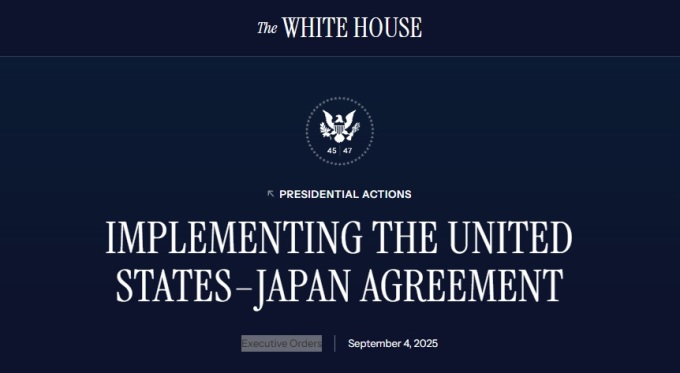
<행정명령 전문>
미일 합의의 이행 행정명령 (IMPLEMENTING THE UNITED STATES–JAPAN AGREEMENT : Executive Orders)
미합중국 헌법과 법률, 특히 「국제긴급경제권한법(50 U.S.C. 1701 이하)」(IEEPA), 「국가비상사태법(50 U.S.C. 1601 이하)」, 「1962년 무역확장법」 제232조(19 U.S.C. 1862, 이하 "제232조"), 「1974년 무역법」 제604조(19 U.S.C. 2483), 그리고 「미합중국 법전」 제3편 제301조에 따라 대통령으로서 내게(트럼프) 부여된 권한에 의거하여, 다음과 같이 결정하고 명령한다.
제1조. 배경
2025년 7월 22일, 나는 미국과 일본 간의 틀 합의(이하 "합의")를 발표하였다. 이 합의는 상호 호혜 원칙과 양국의 공동 국가 이익에 기반한 새로운 미일 통상 관계의 기초를 마련한다. 합의는 미국 생산자들에게 공정한 경쟁 환경을 제공하고 미국의 국가안보 필요를 반영하는 관세 체계를 확립한다.
나의 판단으로, 이 합의는 2025년 4월 2일 발표된 행정명령 14257호(미국 상품의 연간 무역적자 확대·지속에 기여하는 무역 관행을 시정하기 위한 상호 관세 부과를 통한 수입 규제)에 선포된 국가비상사태에 대처하기 위해 필요하고 적절하다.
또한 2018년 3월 8일 발표된 포고령 9704호(미국으로의 알루미늄 수입 조정) 개정본, 포고령 9705호(미국으로의 철강 수입 조정) 개정본, 2019년 5월 17일 포고령 9888호(미국으로의 자동차 및 자동차 부품 수입 조정) 개정본, 2025년 7월 30일 포고령 10962호(미국으로의 구리 수입 조정)에서 제기된 국가안보 위협을 완화하거나 제거하기 위해 필요하다.
이 합의는 미국의 무역적자를 축소하고, 미국 경제를 활성화하며, 제조업 및 국방 산업 기반을 강화함으로써 무역적자가 초래하는 결과에 대응할 것이다.
합의에 따라 미국은 일본산 수입품 대부분에 대해 기본(baseline) 15% 관세를 부과하고, 자동차·자동차 부품, 항공우주 제품, 제네릭 의약품, 미국 내에서 생산 불가능하거나 존재하지 않는 자원류에 대해서는 별도의 부문별 조치를 실시한다.
이러한 새로운 관세 체계는 미국의 대일 무역적자 축소, 수출 확대, 투자기반 생산 증대를 통해 미국의 전체 무역 균형 회복에 기여할 것이다.
한편 일본은 미국 제조업, 항공우주, 농업, 식품, 에너지, 자동차, 산업재 부문 생산자들에게 핵심 분야의 시장 접근에서 전례 없는 기회를 제공한다.
구체적으로 일본 정부는 기존 최저 접근 조항(minimum access) 쌀 계획 내 미국산 쌀 수입을 75% 증대하는 방안의 조기 시행을 추진하고, 옥수수·대두·비료·바이오에탄올(지속가능 항공연료용 포함) 및 기타 미국산 농산물을 연간 80억 달러 규모로 구매할 예정이다.
또한 일본 정부는 미국에서 생산되고 미국 안전기준을 충족한 승용차를 추가 검사 없이 자국 내 판매를 허용할 것이다. 이와 별도로 일본은 미국산 민간 항공기와 미국 방위 장비를 구매한다.
더욱 중요한 점은, 미국 역사상 그 어떤 협정과도 달리 일본 정부가 미국에 5,500억 달러를 투자하기로 합의했다는 것이다. 이 투자는 미국 정부의 선택에 따라 집행되며, 수십만 개의 일자리를 창출하고, 국내 제조 기반을 확충하며, 세대를 이어 미국의 번영을 보장할 것이다.
나의 판단으로, 다음의 조치는 미국 국가 이익에 부합하며, 행정명령 14257호에서 선포된 국가비상사태에 대처하고 선포문 9704호·9705호·9888호·10962호에서 확인된 국가안보 위협을 완화 또는 제거하기 위하여 필요하고 적절하다.
제2조. 일반 관세(General Tariffs)
(a) 일본산 제품에 부과되는 추가 종가세율(ad valorem rate) 은 미국 「통일관세표(Harmonized Tariff Schedule of the U.S., HTSUS)」 제1열("제1열 세율")의 현행 종가세율(또는 이에 해당하는 종가 상당 세율)에 따라 결정된다.
일본산 제품의 제1열 세율이 15% 미만일 경우, 해당 제1열 세율과 본 명령에 따른 추가 세율의 합이 15%가 되도록 한다.
제1열 세율이 15% 이상인 경우 추가 세율은 0%로 한다.
특정 단가 또는 복합 관세율의 처리 방식은 2025년 7월 31일 발표된 행정명령 14326호(상호 관세율 추가 조정)에 따른 EU 제품과 동일하게 적용한다.
본 항의 세율은 개정된 행정명령 14257호에 따라 일본산 제품에 부과되었던 기존 추가 종가세를 대체한다.
(b) (a)항에서 달리 규정된 경우를 제외하고, 개정된 행정명령 14257호의 규정은 일본산 제품에 계속 적용된다.
(c) 상무장관은 무역대표부 대표, 국토안보부 장관(세관국경보호국장 경유), 국제무역위원회 위원장과 협의하여 본 명령 시행을 위해 HTSUS 개정이 필요한지를 결정하고, 필요 시 연방관보에 공고하여 개정할 수 있다.
(d) (a)항에 따른 관세는 2025년 8월 7일 동부일광절약시간 오전 0시 1분 이후 미국 내 소비용으로 수입되거나 저장창고에서 인출된 일본산 제품에 소급 적용된다. 환급은 관련 법률과 세관국경보호국(CBP)의 표준 절차에 따라 처리된다.
(e) 상무장관은 본 조 시행을 위해 규칙·규정·지침·절차를 수립할 수 있으며, 여기에는 "일본산 제품"의 범위에 대한 판단 기준도 포함된다.
제3조. 항공우주
(a) WTO 민간항공기무역협정에 해당하는 일본산 제품(무인 항공기는 제외)에 대해서는, 다음의 대통령 조치 및 개정판을 통해 부과된 관세가 연방관보 게재일을 기준으로 더 이상 적용되지 않는다:
행정명령 14257호(개정판)
선포문 9704호(개정판)
선포문 9705호(개정판)
선포문 10962호
(b) 본 명령이 연방관보에 게재된 날로부터 7일 이내에, 상무장관은 무역위원회 위원장 및 세관국경보호국장과 협의하여 HTSUS 개정을 공고해야 한다.
(c) 상무장관은 일본산 제품 범위 판단 등 본 조 실행을 위한 규칙·규정·지침·절차를 수립할 수 있다.
제4조. 자동차 및 자동차 부품
(a) 연방관보 공고일을 기준으로, 2025년 3월 26일 선포문 10908호(개정판, 미국 자동차 및 자동차 부품 수입 조정)에 따라 일본산 자동차·부품에 부과된 제232조 추가 종가세는 다음 기준으로 조정된다:
제1열 세율이 15% 미만인 경우, 해당 세율과 추가세율의 합이 15%가 되도록 한다.
제1열 세율이 15% 이상인 경우, 추가 세율은 0%로 한다.
(b) 본 명령이 연방관보에 게재된 날로부터 7일 이내에, 상무장관은 무역위원회 위원장 및 세관국경보호국장과 협의하여 HTSUS 개정을 공고해야 한다.
(c) 상무장관은 일본산 여부를 판단하는 규칙을 포함, 본 조 실행에 필요한 규정·지침·절차를 수립할 수 있다.
제5조. 상호관세 적용 제외 품목
(a) 합의 이행을 위해, 상무장관은 개정된 행정명령 14257호에 따른 상호관세를 일본산 천연자원(미국 내에서 공급 불가능하거나 수요 충족 불가한 경우), 제네릭 의약품, 제네릭 의약품 원료, 제네릭 의약품 화학 전구체에 대해 0%로 조정할 권한을(is authorized to modify)을 지닌다.
(b) 상호관세를 0%로 할 품목의 결정 시, 상무장관은 미국 국익, 본 명령의 목적, 개정된 행정명령 14257호의 비상사태 대응 필요, 제232조에 따른 국가안보 위협 해소 필요를 고려해야 한다. 또한 협정에 따른 일본 정부의 공약 범위와 성격, 협정에 따른 미국의 공약 범위와 성격, 협정에 따른 공약을 이행하기 위해 일본 정부가 취한 조치, 미국이 협정에 따른 공약을 이행하기 위해 취한 조치를 포함해 적절하다고 생각하는 요소를 고려해야 한다.
제6조. 모니터링 및 수정
(a) 상무장관은 일본의 합의 이행 상황을 지속적으로 감독하고, 필요 시 대통령에게 보고해야 한다.
(b) 일본이 합의를 이행하지 않을 경우, 나는 개정 행정명령 14257호와 관련 선포문(9704, 9705, 9888, 10962)에서 규정된 국가안보 위협에 대응하기 위해 본 명령을 수정할 수 있다.
제7조. 권한 위임
(a) 상무장관과 국토안보부 장관은, 관련 법에 따라 본 명령을 시행하기 위한 모든 필요한 조치를 취할 권한이 부여된다. 여기에는 규정의 일시적 중단·개정, 연방관보 공고, 규칙·지침 수립 등이 포함된다. 또한 IEEPA 및 제232조에 따라 대통령에게 부여된 권한을 행사할 수 있다.
(b) 국토안보부 장관은 무역위원회 위원장과 협의하여 HTSUS 추가 개정 여부를 결정할 수 있으며, 필요 시 연방관보에 공고할 수 있다. 필요하다면 다른 고위 관계자와도 협의한다.
(c) 상무장관 및 국토안보부 장관은 소관 부처·기관 내에서 이러한 권한을 재위임할 수 있다.
(d) 모든 행정부 부처·기관은 본 명령 이행을 위해 권한 범위 내 필요한 조치를 취해야 한다.
제8조. 다른 대통령 조치와의 관계
이 명령과 상충하는 기존 선포문·행정명령의 규정은, 그 상충 범위에 한하여 본 명령이 우선한다.
제9조. 일반 규정
(a) 본 명령의 어떤 내용도 다음을 방해하거나 침해하는 것으로 해석되어서는 안 된다:
i 법률에 따라 행정부 부처·기관, 또는 그 장에게 부여된 권한
ii 예산관리국(OMB) 국장의 예산·행정·입법 제안 관련 기능
(b) 본 명령은 관련 법률의 범위 내에서, 그리고 예산 범위 안에서 시행된다.
(c) 본 명령은 어떠한 권리나 이익(실체적·절차적 권리 모두)을 법 또는 형평법에 따라 미국, 그 부처·기관·직원·대리인, 기타 개인에 대해 주장하거나 집행할 수 있도록 의도되거나 그렇게 해석되지 않는다.
(d) 본 명령의 공표 비용은 상무부가 부담한다.
2025년 9월 4일 백악관 도널드 트럼프 (DONALD J. TRUMP, THE WHITE HOUSE, September 4, 2025)
<이하 영어 전문>
IMPLEMENTING THE UNITED STATES–JAPAN AGREEMENT
Executive Orders
By the authority vested in me as President by the Constitution and the laws of the United States of America, including the International Emergency Economic Powers Act (50 U.S.C. 1701 et seq.) (IEEPA), the National Emergencies Act (50 U.S.C. 1601 et seq.), section 232 of the Trade Expansion Act of 1962, as amended (19 U.S.C. 1862) (section 232), section 604 of the Trade Act of 1974, as amended (19 U.S.C. 2483), and section 301 of title 3, United States Code, I hereby determine and order:
Section 1. Background. On July 22, 2025, I announced a framework agreement between the United States and Japan (Agreement), which lays the foundation for a new era of United States-Japan trade relations grounded in principles of reciprocity and our shared national interests. The Agreement establishes a tariff framework that levels the playing field for American producers and accounts for American national security needs. In my judgment, the Agreement is necessary and appropriate to address the national emergency declared in Executive Order 14257 of April 2, 2025 (Regulating Imports With a Reciprocal Tariff To Rectify Trade Practices That Contribute to Large and Persistent Annual United States Goods Trade Deficits), as amended, and to reduce or eliminate the threats to national security found in Proclamation 9704 of March 8, 2018 (Adjusting Imports of Aluminum Into the United States), as amended; Proclamation 9705 of March 8, 2018 (Adjusting Imports of Steel Into the United States), as amended; Proclamation 9888 of May 17, 2019 (Adjusting Imports of Automobiles and Automobile Parts Into the United States), as amended; and Proclamation 10962 of July 30, 2025 (Adjusting Imports of Copper Into the United States). The Agreement will reduce the United States trade deficit, boost the economy of the United States, and address the consequences of the United States trade deficit, including by strengthening the manufacturing and defense industrial base of the United States.
Under the Agreement, the United States will apply a baseline 15 percent tariff on nearly all Japanese imports entering the United States, alongside separate sector-specific treatment for automobiles and automobile parts; aerospace products; generic pharmaceuticals; and natural resources that are not naturally available or produced in the United States. This new tariff framework, combined with expanded United States exports and investment-driven production, will help reduce the trade deficit with Japan and restore greater balance to the overall United States trade position.
Japan, meanwhile, will provide American manufacturing, aerospace, agriculture, food, energy, automobile, and industrial goods producers with breakthrough openings in market access across key sectors. Specifically, the Government of Japan is working toward an expedited implementation of a 75 percent increase of United States rice procurements within the Minimum Access rice scheme and purchases of United States agricultural goods, including corn, soybeans, fertilizer, bioethanol (including for sustainable aviation fuel), as well as other United States products, in amounts totaling $8 billion per year. The Government of Japan is also working to accept for sale in Japan United States-manufactured and United States-safety-certified passenger vehicles without additional testing. Separately, Japan will purchase United States-made commercial aircraft, as well as United States defense equipment.
Critically, unlike any other agreement in American history, the Government of Japan has agreed to invest $550 billion in the United States. These investments — which will be selected by the United States Government — will generate hundreds of thousands of United States jobs, expand domestic manufacturing, and secure American prosperity for generations.
In my judgment, I determine that the following actions are consistent with the national interest of the United States and are necessary and appropriate to address the national emergency declared in Executive Order 14257, as amended, and to reduce or eliminate the threats to national security found in Proclamation 9704, as amended; Proclamation 9705, as amended; Proclamation 9888, as amended; and Proclamation 10962.
Sec. 2. General Tariffs. (a) The additional ad valorem rate of duty applicable to products of Japan shall be determined by a product's current ad valorem (or ad valorem equivalent) rate of duty under column 1 of the Harmonized Tariff Schedule of the United States (HTSUS) ("Column 1 Duty Rate"). For a product of Japan with a Column 1 Duty Rate in the HTSUS that is less than 15 percent, the sum of its Column 1 Duty Rate and the additional ad valorem rate of duty pursuant to this order shall be 15 percent. For a product of Japan with a Column 1 Duty Rate that is at least 15 percent, the additional rate of duty pursuant to this order shall be zero percent. Treatment of specific or compound duty rates shall be identical to the treatment provided to products of the European Union as outlined in Executive Order 14326 of July 31, 2025 (Further Modifying the Reciprocal Tariff Rates). The duties described in this subsection shall apply in lieu of the additional ad valorem duties previously imposed on products of Japan under Executive Order 14257, as amended.
(b) Except as provided in subsection (a) of this section, the terms of Executive Order 14257, as amended, shall continue to apply to products of Japan.
(c) The Secretary of Commerce (Secretary), in consultation with the United States Trade Representative; the Secretary of Homeland Security, acting through the Commissioner of U.S. Customs and Border Protection (CBP); and the Chair of the United States International Trade Commission (ITC), shall determine whether modifications to the HTSUS are necessary or appropriate to effectuate this order and may make such modifications through notice in the Federal Register.
(d) The tariffs set forth in subsection (a) of this section shall apply retroactively to products of Japan entered for consumption or withdrawn from warehouse for consumption on or after 12:01 a.m. eastern daylight time on August 7, 2025. Any refunds shall be processed pursuant to applicable laws and CBP's standard procedures for such refunds.
(e) The Secretary may issue rules, regulations, guidance, and procedures to carry out the provisions of this section, including rules for determining what are "products of Japan" for purposes of this section.
Sec. 3. Aerospace. (a) With respect to products of Japan that fall under the World Trade Organization Agreement on Trade in Civil Aircraft, except for unmanned aircraft, the tariffs imposed through the following Presidential actions and subsequent amendments to those actions shall no longer apply, as of the date of publication of the Federal Register notice described in subsection (b) of this section:
(i) Executive Order 14257, as amended;
(ii) Proclamation 9704, as amended;
(iii) Proclamation 9705, as amended; and
(iv) Proclamation 10962.
(b) Within 7 days of the date of publication of this order in the Federal Register, the Secretary, in consultation with the Chair of the ITC and the Commissioner of CBP, shall publish a notice in the Federal Register modifying the HTSUS consistent with this section.
(c) The Secretary may issue rules, regulations, guidance, and procedures to carry out the provisions of this section, including rules for determining what are "products of Japan" for purposes of this section.
Sec. 4. Automobiles and Automobile Parts. (a) As of the date of publication of the Federal Register notice described in subsection (b) of this section, in lieu of the additional section 232 ad valorem duties imposed on products of Japan in Proclamation 10908 of March 26, 2025 (Adjusting Imports of Automobiles and Automobile Parts Into the United States), as amended, the additional ad valorem rate of duty applicable to an automobile or automobile part that is a product of Japan and subject to duties under Proclamation 10908, as amended, shall be determined by the product's Column 1 Duty Rate. For a product of Japan with a Column 1 Duty Rate that is less than 15 percent, the sum of its Column 1 Duty Rate and the additional automobile or automobile part section 232 ad valorem rate of duty pursuant to this order shall be 15 percent. For a product of Japan with a Column 1 Duty Rate that is at least 15 percent, the additional automobile or automobile part section 232 ad valorem rate of duty imposed shall be zero percent.
(b) Within 7 days of the date of publication of this order in the Federal Register, the Secretary, in consultation with the Chair of the ITC and the Commissioner of CBP, shall publish a notice in the Federal Register modifying the HTSUS consistent with this section.
(c) The Secretary may issue rules, regulations, guidance, and procedures to carry out the provisions of this section, including rules for determining whether automobiles and automobile parts are "products of Japan" for purposes of this section.
Sec. 5. Products Not Subject to Reciprocal Tariffs. (a) To implement the terms of the Agreement, the Secretary is authorized to modify the reciprocal tariff rate imposed under Executive Order 14257, as amended, to zero percent for products of Japan that are natural resources unavailable (or unavailable at sufficient scale to satisfy domestic demand) in the United States, generic pharmaceuticals, generic pharmaceutical ingredients, and generic pharmaceutical chemical precursors.
(b) In determining when and for which products to modify the reciprocal tariff rate to zero percent, the Secretary shall act in a manner consistent with the national interests of the United States; the purposes of this order; the need to deal with the national emergency declared in Executive Order 14257, as amended; and the need to reduce or eliminate the threats to national security that I found pursuant to section 232. The Secretary shall also consider factors he deems appropriate, including the scope and nature of the commitments of the Government of Japan under the Agreement; the scope and nature of the commitments of the United States under the Agreement; the actions taken by the Government of Japan to implement its commitments under the Agreement; and the actions taken by the United States to implement its commitments under the Agreement.
Sec. 6. Monitoring and Modifications. (a) The Secretary shall monitor the progress of Japan's implementation of its commitments under the Agreement and shall, from time to time, update me on the status of Japan's implementation.
(b) Should Japan fail to implement its commitments under the Agreement, I may modify this order as necessary to deal with the emergency declared in Executive Order 14257, as amended, and to reduce or eliminate the threats to national security found in Proclamation 9704, as amended; Proclamation 9705, as amended; Proclamation 9888, as amended; and Proclamation 10962.
Sec. 7. Delegation. (a) Consistent with applicable law, the Secretary and the Secretary of Homeland Security are directed and authorized to take all necessary actions to implement and effectuate this order — including through temporary suspension or amendment of regulations or through notices in the Federal Register and by adopting rules, regulations, or guidance — and to employ all powers granted to the President, including those granted by IEEPA and section 232, as may be necessary to implement and effectuate this order.
(b) The Secretary of Homeland Security, in consultation with the Chair of the ITC, shall determine whether additional modifications to the HTSUS are necessary to effectuate this order and may make such modifications through notice in the Federal Register. The Secretary of Homeland Security shall consult with any senior officials she deems appropriate.
(c) Consistent with applicable law, the Secretary and the Secretary of Homeland Security may, consistent with applicable law, redelegate any of these functions within their respective department or agency.
(d) All executive departments and agencies shall take all appropriate measures within their authority to implement this order.
Sec. 8. Interaction With Other Presidential Actions. Any provision of previous proclamations and Executive Orders that is inconsistent with the actions directed in this order is superseded to the extent of such inconsistency.
Sec. 9. General Provisions. (a) Nothing in this order shall be construed to impair or otherwise affect:
(i) the authority granted by law to an executive department or agency, or the head thereof; or
(ii) the functions of the Director of the Office of Management and Budget relating to budgetary, administrative, or legislative proposals.
(b) This order shall be implemented consistent with applicable law and subject to the availability of appropriations.
(c) This order is not intended to, and does not, create any right or benefit, substantive or procedural, enforceable at law or in equity by any party against the United States, its departments, agencies, or entities, its officers, employees, or agents, or any other person.
(d) The costs for publication of this order shall be borne by the Department of Commerce.
DONALD J. TRUMP
THE WHITE HOUSE,
September 4, 2025.